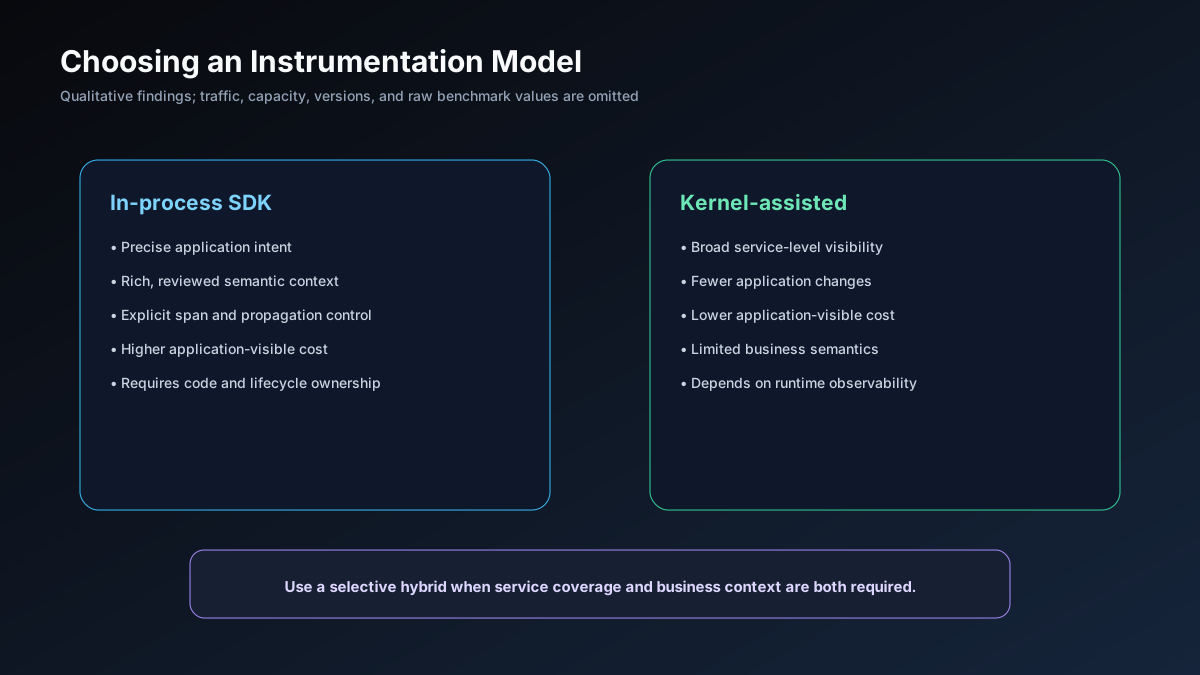
A security-safe, qualitative comparison of kernel-assisted auto-instrumentation and in-process OpenTelemetry SDKs, covering overhead, semantic context, privacy, and hybrid design.
- Primary Domain
- Observability & eBPF
- System Scope
- Baremetal Production Forensics
- Telemetry Standard
- Deterministic Verification
Executive summary
There is no universally “zero-overhead” tracing method. Kernel-assisted auto-instrumentation and in-process OpenTelemetry SDKs move cost and capability to different places. We compared the two approaches under a synthetic high-throughput workload and found a practical trade-off: auto-instrumentation reduced application-visible overhead, while SDK instrumentation produced richer, intentional business context.
This article reports qualitative, normalized findings. It intentionally omits traffic volume, host topology, dependency versions, endpoints, payloads, queries, collector configuration, sampling values, and raw benchmark results.
The two instrumentation models
In-process SDK instrumentation runs with the application. It can attach domain-aware attributes, propagate context through code paths, and describe work that is not visible at the network boundary. That expressiveness has a cost: additional allocations, serialization, and export activity share the application’s resources.
Kernel-assisted auto-instrumentation observes selected runtime and network behavior outside the application process. It can provide useful service-level traces with little code change and lower application-visible cost. It cannot reliably infer every business operation, asynchronous boundary, or application-specific outcome.
Neither model is automatically safer or more complete. The right choice depends on the questions the telemetry must answer.
Evaluation method
We exercised equivalent service behavior across a baseline, an SDK-instrumented variant, and an auto-instrumented variant. The review considered CPU demand, allocation pressure, tail latency, trace continuity, and the usefulness of captured attributes.
All published results are directional:
The raw load profile and metric values remain private because they could reveal capacity and scaling assumptions.
| Area | SDK instrumentation | Kernel-assisted instrumentation |
|---|---|---|
| Application CPU and allocations | Higher | Lower |
| Domain-specific context | Strong | Limited |
| Initial code changes | More | Fewer |
| Control over span boundaries | Precise | Protocol-dependent |
| Operational dependency | Application and exporter | Host/runtime observer and collector |
What the comparison showed
Auto-instrumentation was effective for quickly establishing service maps, latency distributions, and request relationships without placing the same allocation burden inside the service. SDK instrumentation remained more useful where engineers needed explicit operation names, asynchronous context, or attributes tied to application decisions.
The strongest result was a hybrid design. Broad service-level visibility can come from auto-instrumentation, while carefully selected SDK spans cover business-critical transitions. This avoids instrumenting every code path while preserving the context needed for debugging and service-level analysis.
Privacy and security boundaries
Telemetry must not collect secrets, credentials, customer identifiers, raw request bodies, database statements, or authentication material merely because an instrumentation method can observe them. Attribute allow-lists, data minimization, retention controls, and access review are part of the instrumentation design.
The comparison did not test bypass techniques or disclose collector routes, sampling thresholds, firewall rules, or payload structure. Those details are unnecessary for the architectural lesson.
Decision guidance
Choose auto-instrumentation when the priority is broad adoption, low code churn, and service-level behavior. Choose SDK instrumentation when the trace must express application intent. Use both selectively when operational visibility and business semantics are equally important.
Any production decision should be validated against the service’s own workload. Synthetic results demonstrate direction, not a permanent performance guarantee.
Need a second opinion on Kubernetes storage, HA, or telemetry architecture?
I help platform engineering teams identify redundant storage layers, eliminate latency bottlenecks, and harden high-concurrency production platforms against silent failure modes.