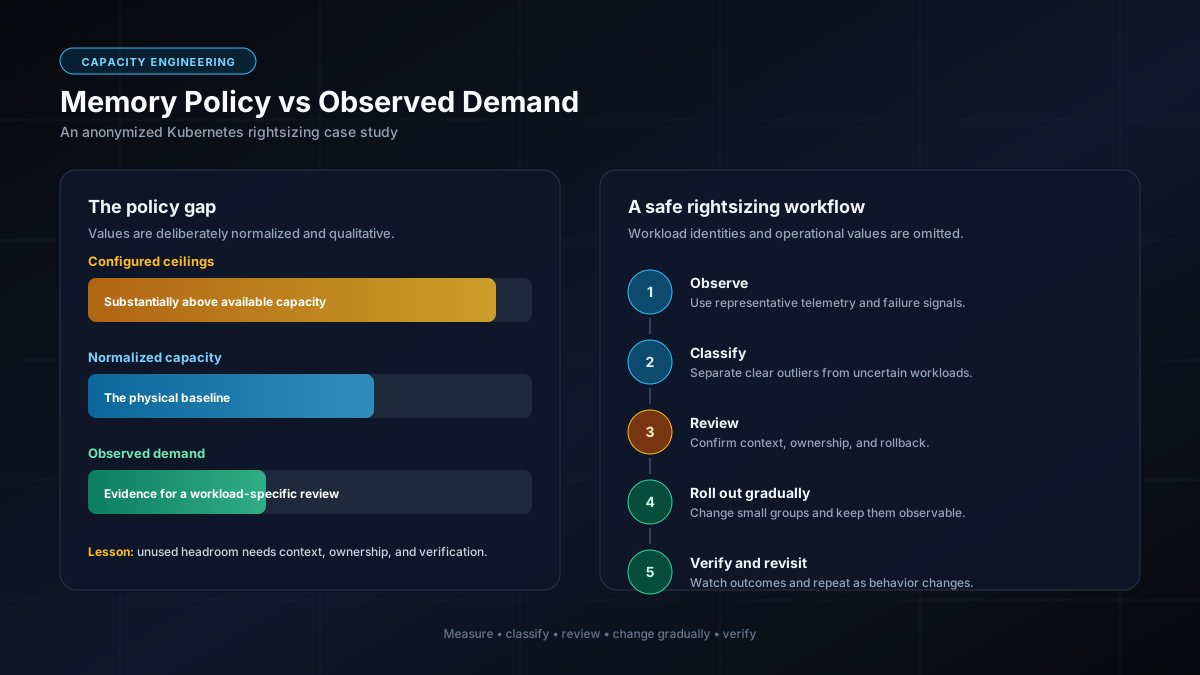
A telemetry review found that configured Kubernetes memory ceilings exceeded available capacity by more than threefold. This anonymized case study explains how to identify policy drift, stage safer changes, and verify the outcome without exposing operational details.
- Primary Domain
- Kubernetes & SRE
- System Scope
- Baremetal Production Forensics
- Telemetry Standard
- Deterministic Verification
Executive summary
A capacity review found that the combined memory ceilings configured for a Kubernetes environment were more than three times its allocatable memory. The headline figure is an illustrative, synthetic multiple: it illustrates policy drift, not a disclosure of physical capacity or cluster layout.
To prevent infrastructure fingerprinting and telemetry correlation, all capacity metrics in this case study are expressed as normalized ratios rather than operational values. Across the reviewed environment, configured memory ceilings exceeded total allocatable capacity by more than threefold (an aggregate overcommit ratio greater than 3:1), scheduled requests committed approximately three-quarters (75–80%) of allocatable capacity, and the actual peak working-set demand remained comfortably below two-thirds of physical capacity. These are editorial approximations, not the underlying telemetry, and they must not be used for operational planning.
Discussion of capacity boundaries uses unmapped conceptual roles without disclosing real hostnames, cluster topology, or infrastructure mappings.
That gap did not mean the cluster was continuously using more memory than it had. It meant many workloads were allowed to grow far beyond their observed needs at the same time. Because memory cannot be throttled in the same way as CPU, correlated growth could have turned a quiet configuration problem into node-level contention and forced termination.
We used historical telemetry, workload context, and staged validation to reduce the clearest mismatches. The work improved the relationship between configured policy and observed demand. It did not prove that memory risk had been eliminated, and the environment remains subject to ongoing review.
Why the numbers can be misleading
Kubernetes memory requests and limits answer different questions.
A request tells the scheduler how much memory to reserve when placing a workload. A limit is the runtime ceiling enforced for that container. The scheduler does not require the sum of all limits to fit within physical capacity, so the configured ceilings can add up to far more memory than the environment could supply if every workload grew at once.
That flexibility can be useful. Independent workloads rarely peak together, and conservative limits can absorb short-lived growth. The risk appears when generous defaults become permanent, exceptional values lose their rationale, or several workloads share the same burst pattern.
We use the term "ghost limits" for the portion of configured headroom that has no current evidence or documented operational reason. It is not a Kubernetes feature or a vulnerability. It is a sign that declared policy and observed behavior have drifted apart.
Why memory needs a cautious approach
CPU pressure is usually visible as throttling and latency. Memory pressure is less forgiving. A container that reaches its memory ceiling can be terminated, while broader host pressure can affect unrelated workloads on the same node.
That is why low recent usage is not, by itself, permission to cut a limit. A safe review also considers startup behavior, cache growth, batch jobs, maintenance tasks, seasonal peaks, data volume, dependency behavior, and known failure modes. Stateful services and workloads with infrequent but legitimate spikes deserve particular care.
The goal is not to make every limit tight. The goal is to make every limit explainable.
A telemetry-led review
We began with an inventory of requests, limits, and observed working-set behavior over a representative rolling period. The evidence was reviewed alongside restart and eviction signals, workload ownership, and the operational purpose of each service.
The review separated workloads into three broad groups:
• Clear outliers, where the configured ceiling was far above both normal and peak behavior and no documented exception justified the gap. - Context-dependent workloads, where telemetry suggested room for change but workload owners needed to validate uncommon execution paths. - Sensitive or uncertain workloads, where the evidence was incomplete or the cost of an incorrect reduction was too high.
This classification prevented a cluster-wide search-and-replace. Each recommendation was workload-specific, included a safety margin, and was treated as a hypothesis to validate rather than a universal formula.
Staged remediation
The first remediation phase focused only on clear outliers. Changes were introduced in small groups, reviewed by the relevant owners, and observed before the next group was considered. Rollback paths remained available throughout the validation window.
For each change we checked:
• whether ordinary and peak behavior still fit within the revised policy; - whether memory-related restarts, evictions, or instability increased; - whether performance or background processing regressed; - whether the scheduler gained useful placement flexibility; and - whether the documented rationale still matched the workload's role.
The staged rollout materially reduced inflated ceilings for the reviewed workloads. During the monitored validation period, the reviewed changes did not show an increase in memory-related restart signals. That observation is limited to the validation period and should not be read as a guarantee of future behavior.
Governance matters more than one audit
Configuration drift returns unless the operating process changes with it. We therefore paired the remediation with governance practices:
• Resource settings need an owner and a short rationale. - Shared defaults are starting points, not permanent workload-specific answers. - Exceptional headroom should be documented and revisited. - Reviews should use a representative window and include known seasonal or maintenance events. - Material reductions should be staged, observable, and reversible. - Alerts should identify meaningful divergence without publishing sensitive operational thresholds.
These controls make future reviews less dependent on institutional memory and reduce the chance that an old emergency setting quietly becomes the new normal.
What we learned
The most important lesson was not that overcommitment is inherently wrong. It was that overcommitment must be intentional.
A large sum of limits can coexist with a healthy environment when peaks are independent, safety margins are justified, and telemetry supports the model. The same aggregate can be dangerous when values are copied forward without ownership or when several workloads can grow together.
Requests, limits, and observed use should be read as a system:
• Requests influence placement and reserved capacity. - Limits bound individual growth. - Telemetry tests whether those assumptions remain credible. - Workload context explains behavior that a dashboard cannot.
The result is a repeatable practice: measure, classify, review, change gradually, and verify. It replaces inherited guesses with evidence while preserving the safety margins that real production systems need.
Limits of this case study
This article intentionally omits environment topology, component identities, queries, configuration values, exact capacity figures, thresholds, and operational procedures. All capacity relationships are expressed as normalized ratios rather than operational telemetry, and node references use unmapped conceptual roles. Those safeguards preserve the engineering lesson without exposing infrastructure dimensions or fingerprintable telemetry.
The work described here reduced a verified set of configuration mismatches. It does not establish that every workload is optimally sized, that future peaks will match historical behavior, or that memory-related incidents are impossible. Continued telemetry review and workload-owner validation remain necessary.
Before publication, this case study should receive approval from Security, Legal, Privacy, and Incident Response reviewers.
Need a second opinion on Kubernetes storage, HA, or telemetry architecture?
I help platform engineering teams identify redundant storage layers, eliminate latency bottlenecks, and harden high-concurrency production platforms against silent failure modes.