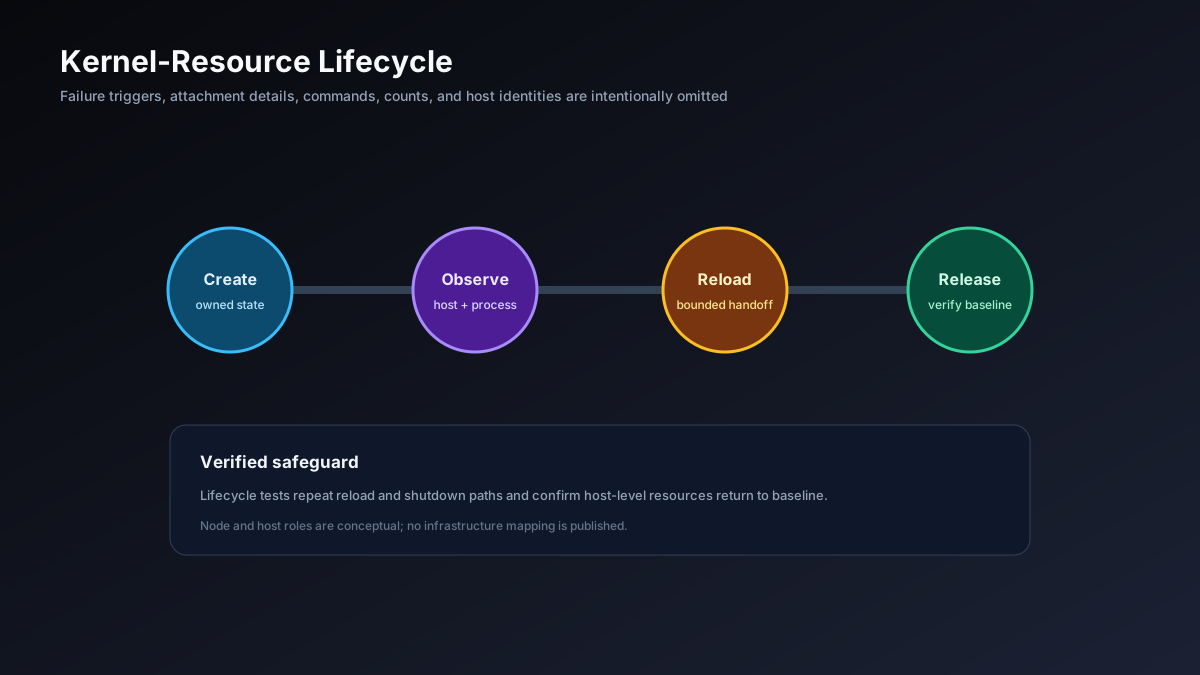
An educational case study and systems engineering reference on kernel resource accounting in Linux telemetry: why user-space process restarts fail to reclaim kernel-resident BPF state, and how to verify lifecycle invariants.
- Primary Domain
- Kernel & eBPF
- System Scope
- Baremetal Production Forensics
- Telemetry Standard
- Deterministic Verification
Executive summary
In Linux platform engineering, telemetry and observability daemons frequently bridge the boundary between user-space application runtimes and kernel-resident instrumentation. When kernel-space resources are allocated by an agent, their lifecycle is governed by kernel object reference counters rather than the user-space process heap.
This case study analyzes a class of failure where unevictable kernel allocations accumulate across telemetry lifecycle events, eventually creating host-level memory pressure that starves network buffer pools and manifests as intermittent TCP connection resets.
Real timestamps, hostnames, topology, traffic volumes, kernel object identifiers, memory values, interfaces, commands, dependency versions, alert thresholds, and reproduction sequences are intentionally omitted. This analysis focuses strictly on the fundamental systems engineering principles: kernel-space memory accounting, object lifecycle invariants, and dual-plane observability.
The systems architecture problem
User-space service runtimes (including container engines and orchestrators) measure application memory through cgroup controllers (memory.current, memory.max). When a telemetry or networking daemon initializes kernel instrumentation—such as socket filters, tracepoints, or BPF maps—those resources reside in kernel memory structures (slab caches, vmalloc space, or socket buffer queues).
Because these kernel structures are managed by the operating system kernel:
1. They do not appear in the daemon's user-space heap metrics or container cgroup accounting. 2. Terminating or restarting the user-space process does not automatically reclaim attached or referenced kernel resources if file descriptors, maps, or hooks remain pinned or attached to active kernel subsystem structures. 3. As unreclaimable kernel allocations consume available host memory, the kernel's memory management subsystem experiences pressure. When slab allocations narrow the memory available for network buffer allocation (sk_buff allocations), socket operations fail or timeout, leading to dropped packets and TCP resets.
When troubleshooting, operators relying solely on pod-level metrics see a healthy user-space process while the underlying node suffers silent, unevictable memory exhaustion.
Root cause analysis: Incomplete lifecycle ownership
The fundamental engineering defect in this class of issue is incomplete ownership across the user-space and kernel-space boundary.
When an instrumentation agent reconfigures or restarts its pipeline: - A user-space daemon may treat a configuration reload or process initialization as complete once its user-space routines report readiness. - However, if the teardown of prior kernel hooks, pinned maps, or attached socket structures is asynchronous, incomplete, or unreferenced, the previous kernel allocations persist alongside new allocations. - Over repeated configuration updates or rolling deployments, unreferenced kernel structures accumulate in kernel slab memory.
A successful user-space process reload must never be treated as completion until host-level kernel resource release is deterministically verified.
Observability gap: Why conventional dashboards miss kernel leaks
Standard service-level monitoring dashboards track four primary signals: process RSS, container restarts, request latency, and application error rates. None of these signals differentiate between user-space working sets and kernel-resident slab allocations.
When kernel memory accumulates: - Process memory graphs appear completely flat. - Container restart counts remain zero. - The failure only becomes visible once the host reaches critical memory pressure, manifesting as delayed network allocation or sudden connection resets.
The architectural lesson is that observability instrumentation itself requires dual-plane monitoring: - User-space metrics tracking agent health and event rates. - Host-level kernel telemetry tracking slab allocation categories (/proc/meminfo Slab, SUnreclaim, KReclaimable) and subsystem buffer health. - Automated anomaly detection flagging sustained divergence between user-space activity and kernel memory trends.
Verified engineering remediation
Remediating this class of failure requires enforcing strict resource invariants across both software design and runtime verification:
1. Deterministic Teardown Before Replacement: The instrumentation agent must follow a strict sequential lifecycle contract: existing kernel hooks and maps must be explicitly detached, unpinned, and validated as released before replacement structures are activated. 2. Automated Lifecycle Invariant Testing: CI and qualification pipelines must include repetitive lifecycle test suites that execute repeated reload, restart, and failure sequences while validating that host-level kernel memory returns cleanly to baseline after each cycle. 3. Dual-Plane Host Telemetry: Node monitoring must track unreclaimable slab memory alongside container working sets, raising alerts on sustained upward trends regardless of container cgroup health. 4. Failure Injection & Recovery Validation: Recovery routines must verify not only that the user-space process is active, but that the kernel attachment points are in a known, singular state.
Systems engineering lessons
• Kernel state outlives process boundaries: When applications interact with kernel-resident subsystems, process death or restart does not guarantee resource reclamation. - Teardown requires the same rigor as initialization: Shutdown, reload, and error-recovery paths must receive identical testing depth and deterministic validation as startup routines. - cgroup boundaries do not bound all kernel allocations: Host-level stability requires monitoring kernel slab structures that escape container accounting. - Architectural documentation must teach principles, not exploit recipes: Educational postmortems should illustrate systemic design invariants without publishing reproducible failure steps or internal infrastructure footprints.
Limits of this analysis
This case study is published under responsible-disclosure standards. It does not disclose private endpoints, internal hostnames, cluster topologies, exact measurements, proprietary tools, specific code sequences, or unpatched vulnerabilities.
All findings illustrate generalized Linux kernel systems architecture and reliability principles.
Need a second opinion on Kubernetes storage, HA, or telemetry architecture?
I help platform engineering teams identify redundant storage layers, eliminate latency bottlenecks, and harden high-concurrency production platforms against silent failure modes.