A blameless, anonymized review of how control-plane memory pressure, storage latency, and health-check failures combined into an availability incident—and how verified monitoring changes improved response.
- Primary Domain
- Kubernetes & SRE
- System Scope
- Baremetal Production Forensics
- Telemetry Standard
- Deterministic Verification
Executive summary
This blameless postmortem describes an anonymized availability incident in which control-plane memory pressure, delayed storage writeback, and health-check failures reinforced one another. Real timestamps, hostnames, topology, capacity figures, alert thresholds, storage identifiers, and recovery commands are intentionally omitted.
The affected control-plane host is described by its conceptual role without disclosing hostnames or cluster topology. During the incident, host memory consumption entered a critical pressure band, approaching kernel eviction thresholds and exhausting reclaimable page cache. This describes the behavioral constraint on the host, not operational telemetry or an alert threshold.
The incident caused intermittent control-plane and application availability during a limited window. Post-recovery integrity checks found no evidence of data loss. That conclusion is limited to the checks performed and does not imply that similar failure chains are harmless.
What happened
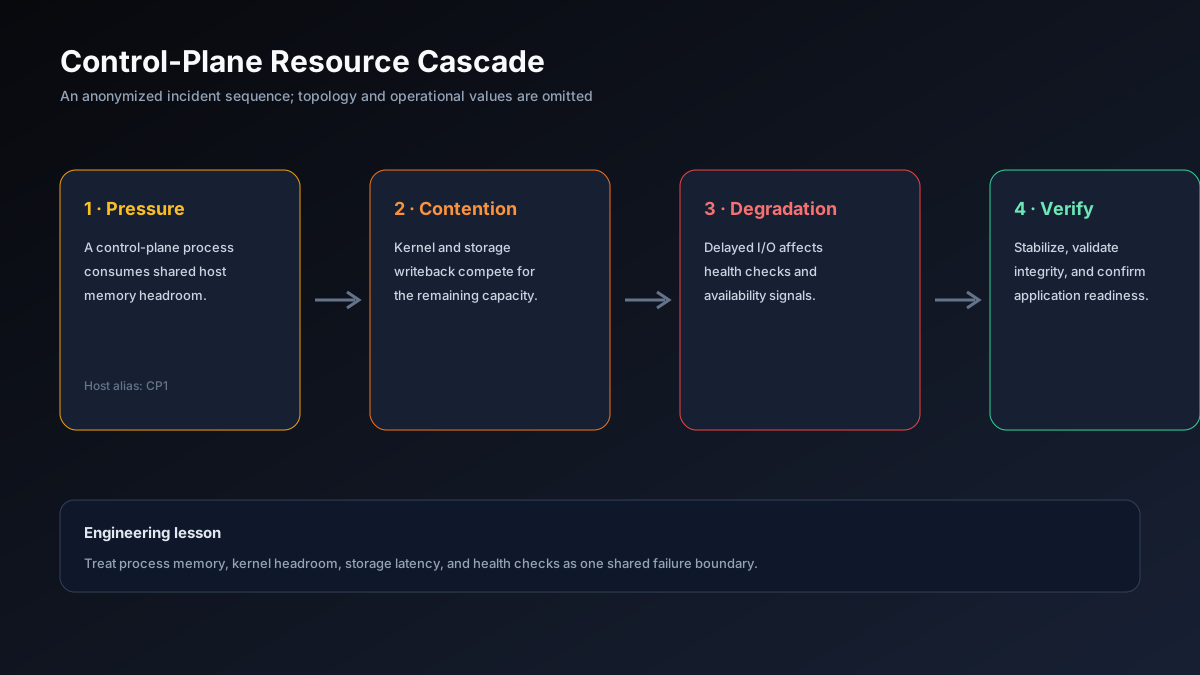
A reconciliation burst increased memory demand in a control-plane process. As available memory narrowed, the operating system had less room for file-backed cache and asynchronous writeback. Storage operations slowed, and processes waiting on those operations became less responsive.
Health checks then began to miss their deadlines. Automated recovery mechanisms correctly detected unhealthy components, but several mechanisms acted close together and increased churn during an already constrained period. The combined behavior mattered more than any single component.
This was a resource-coupling failure: application memory, kernel memory, storage latency, and orchestration health were treated as separate concerns even though they shared the same failure boundary.
Detection and response
The first actionable signal came from external availability monitoring, followed by host-memory and storage-latency indicators. Responders reduced change activity, confirmed the scope, allowed the control plane to stabilize, and then validated storage and application health before restoring normal operations.
The public timeline is intentionally generalized. Exact timestamps, alert sequencing, affected routes, and internal response procedures are retained only in the private incident record.
Contributing factors
• A control-plane process could expand beyond the headroom assumed by the host-capacity model. - Memory and storage signals were reviewed independently, delaying recognition of the shared failure boundary. - Health checks depended on resources that were themselves affected by storage delay. - Concurrent automated recovery actions increased instability during the pressure window. - Capacity assumptions had not been revisited after workload growth.
These factors describe system conditions, not individual mistakes.
Verified corrective actions
Earlier memory-pressure detection has been deployed and verified. The alert provides responders with a broader warning window and links to a revised investigation path that considers host memory, kernel pressure, storage latency, and control-plane health together.
Recovery validation now explicitly checks data integrity and application readiness before an incident is closed. Other architectural improvements remain private follow-up items until they are implemented and verified; they are not presented here as completed safeguards.
Engineering lessons
Control-plane memory should not be evaluated only as a process-level metric. The host also needs working room for kernel structures, file-backed cache, and storage writeback. A system can appear healthy at the application layer while the shared host boundary is already approaching failure.
Health checks should also be examined for correlated dependencies. A probe that relies on the same pressured storage path may report a symptom without distinguishing it from the cause.
Finally, automated recovery is safest when its actions are observable, rate-limited, and tested under degraded conditions. Multiple correct controllers can still produce an undesirable combined response.
Limits of this postmortem
This account does not publish private endpoints, IP addresses, hostnames, node mappings, exact metrics, queries, commands, configuration values, thresholds, storage layout, or failure-reproduction steps. References to control-plane hosts use unmapped conceptual roles and must not be interpreted as a topology inventory.
The verified changes reduce a known class of risk but do not prove that all memory or storage incidents have been eliminated. Continued capacity review, failure testing, and incident-response exercises remain necessary.
Need a second opinion on Kubernetes storage, HA, or telemetry architecture?
I help platform engineering teams identify redundant storage layers, eliminate latency bottlenecks, and harden high-concurrency production platforms against silent failure modes.