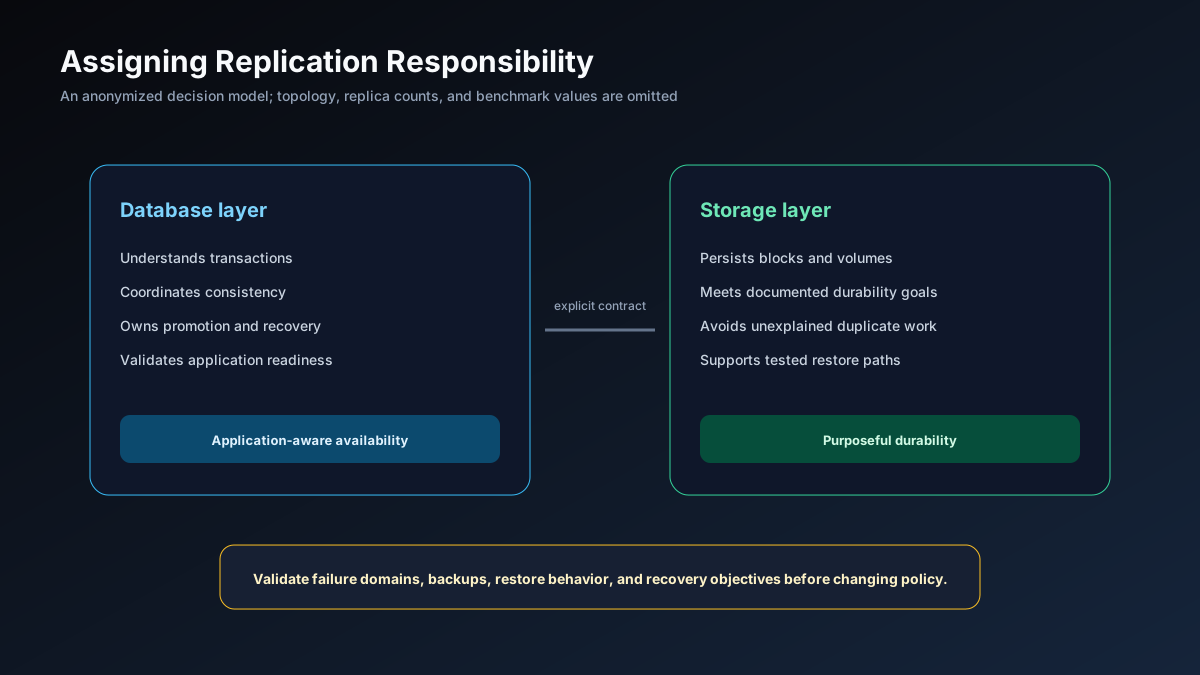
An anonymized case study on assigning recovery responsibility between database and storage layers, reducing duplicated write work without presenting the design as a universal rule.
- Primary Domain
- Storage & Kubernetes
- System Scope
- Baremetal Production Forensics
- Telemetry Standard
- Deterministic Verification
The architectural problem
Stateful platforms often provide resilience at more than one layer. A database operator may replicate data between database instances while the storage platform independently replicates each volume. Both mechanisms are valuable, but combining them without an explicit failure model can duplicate network and storage work without delivering a proportional recovery benefit.
This case study describes an anonymized review of that overlap. It omits database names, topology, node identities, replica counts, storage classes, versions, commands, benchmark parameters, capacity values, and migration procedures.
Why replication can multiply work
Database-level replication understands transactions, logs, consistency, and promotion. Storage-level replication protects blocks and volumes. When both layers independently copy every write across the same failure domain, one logical transaction can produce several rounds of persistence and network acknowledgement.
That does not make either layer wrong. The problem is using both defaults without deciding which layer owns each recovery objective.
Evaluation method
We compared the existing profile with a reduced storage-replication profile while retaining database-managed availability. Tests used equivalent application behavior and reviewed transaction latency, throughput, storage traffic, recovery behavior, and data-integrity checks.
Results are intentionally qualitative:
Raw measurements, load parameters, and infrastructure mappings remain private because they reveal capacity and scaling assumptions.
| Area | Observed direction after the change |
|---|---|
| Transaction latency | Materially lower |
| Throughput | Higher |
| Network storage traffic | Lower |
| Consumed storage capacity | Lower |
| Recovery responsibility | More clearly assigned |
The decision
For the reviewed workload, database-managed replication remained the primary high-availability mechanism and the underlying storage profile was reduced. The choice followed validation of the workload’s recovery objectives and failure domains; it is not a universal recommendation for databases on Kubernetes.
The migration was staged, reversible, and observed through application and storage signals. Integrity and recovery checks completed successfully before the new profile became the default for that workload.
What improved
Removing redundant write paths reduced acknowledgement delay and background storage traffic. It also clarified which layer should be investigated during replication or failover events.
The most valuable outcome was not a single benchmark number. It was an explicit contract between the database and storage layers. Each control now has a documented purpose rather than inheriting a high-availability default independently.
When this approach is inappropriate
A reduced storage-replication profile may be unsuitable when the database has only one instance, failure domains are not independent, recovery objectives require storage-level copies, backups are unverified, or the operator cannot demonstrate reliable promotion and restore behavior.
Teams should validate failure handling, backups, restore time, corruption detection, maintenance procedures, and capacity before changing replication policy.
Limits of this case study
This article does not publish the exact storage configuration, database topology, test commands, performance numbers, network layout, recovery thresholds, or migration sequence. Any node references in related material use unmapped conceptual roles without disclosing cluster topology or host counts.
The verified result applies to one reviewed workload and validation period. It does not prove that reduced storage replication is safe for every database or environment.
Need a second opinion on Kubernetes storage, HA, or telemetry architecture?
I help platform engineering teams identify redundant storage layers, eliminate latency bottlenecks, and harden high-concurrency production platforms against silent failure modes.