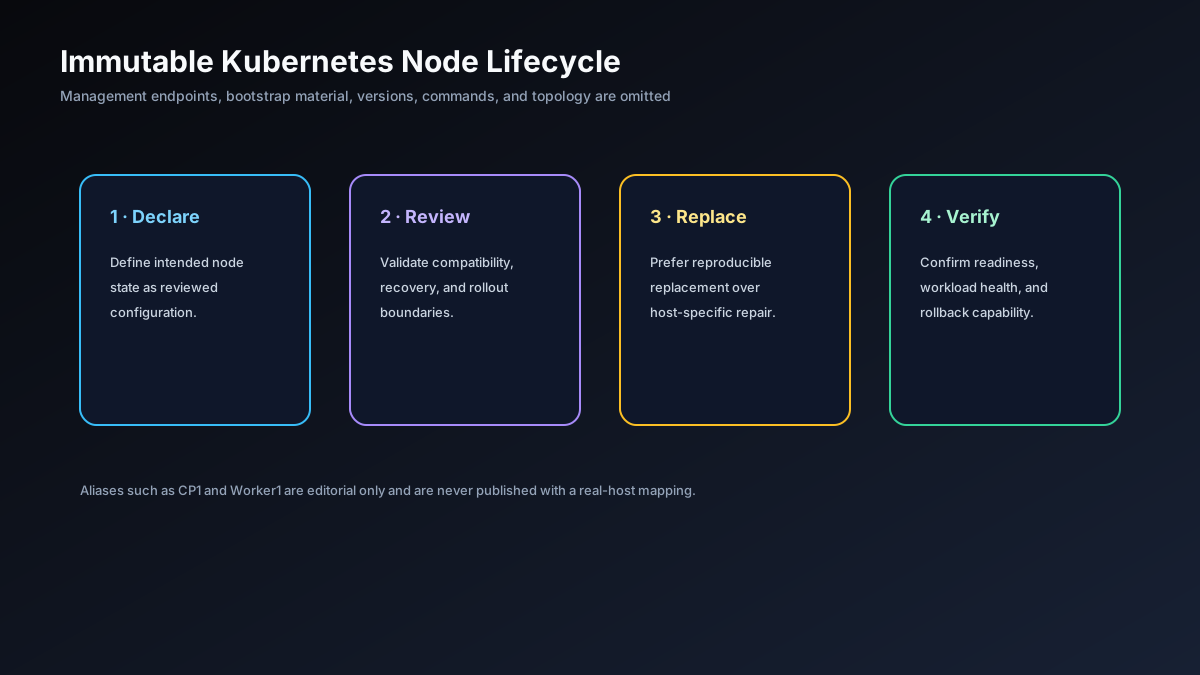
An anonymized architecture decision explaining why a declarative, immutable Kubernetes operating system reduced configuration drift while introducing a stricter operational model.
- Primary Domain
- Talos & Architecture
- System Scope
- Baremetal Production Forensics
- Telemetry Standard
- Deterministic Verification
Status
Accepted after staged validation.
Context
General-purpose operating systems are flexible Kubernetes hosts, but that flexibility can increase lifecycle work. Interactive changes, package drift, locally installed tooling, and host-specific repair steps make it harder to prove that nodes share the same intended state.
We evaluated an immutable, Kubernetes-focused operating system as a way to reduce configuration variance and make node replacement a routine control-plane operation rather than a bespoke host-repair exercise.
This public decision record omits environment topology, hostnames, management endpoints, bootstrap material, configuration values, versions, firewall policy, and operational commands.
Decision
We adopted Talos Linux for the reviewed Kubernetes node roles. The choice was based on a declarative management model, a smaller general-purpose administration surface, consistent node images, and an upgrade path that treats hosts as replaceable infrastructure.
Any node references in supporting material use unmapped conceptual roles. They do not reveal real hostnames or establish how many nodes exist in the environment.
Evaluation criteria
The assessment covered:
• repeatability of provisioning and replacement; - recovery from failed or interrupted upgrades; - compatibility with required storage, networking, and observability functions; - auditability of configuration changes; - operational access during degraded conditions; and - the team’s ability to support the platform without undocumented host changes.
Exact timings and scores were removed. Publicly, the verified result is qualitative: node provisioning became more predictable, configuration drift decreased, and routine lifecycle work required fewer host-specific steps.
Consequences
An immutable platform narrows the supported operating model. Engineers can no longer rely on ad-hoc package installation or manual host repair as the default response. That constraint is beneficial only when declarative configuration, recovery media, break-glass governance, and tested replacement procedures are maintained.
The migration also shifts expertise rather than eliminating it. Teams still need strong knowledge of Kubernetes, networking, storage, certificates, and Linux behavior. The platform reduces certain forms of drift; it does not remove the need for security patching, access control, monitoring, or incident response.
Verified outcomes
The staged rollout and recovery tests completed successfully for the reviewed node roles. Configuration became more consistent and repeatable across replacements. No claim is made that the platform eliminates vulnerabilities or prevents every class of host failure.
Detailed benchmark values, security scores, versions, and recovery procedures remain in private engineering records and require separate review before disclosure.
Follow-up principles
• Keep node configuration declarative and peer-reviewed. - Test upgrades and rollback behavior before broad rollout. - Maintain a documented, access-controlled recovery path. - Revalidate storage and networking compatibility as components change. - Treat immutable infrastructure as one control in a wider defence-in-depth model.
This decision remains subject to periodic review as operational requirements and platform capabilities evolve.
Need a second opinion on Kubernetes storage, HA, or telemetry architecture?
I help platform engineering teams identify redundant storage layers, eliminate latency bottlenecks, and harden high-concurrency production platforms against silent failure modes.